
March 2018
Getting Involved
20/03/18 20:51
Hi everyone, firstly, thank you for taking the time to read my article! I really appreciate it. What I hope to accomplish in this article is to give you a first-hand perspective of why getting involved is so important. To start off, my name is Amogh Kadhe and I am a 4 th year student at the University of Alberta. I am a student, a speaker, and a volunteer. I have been volunteering with various organizations throughout high school and university and I have learned a lot from every experience. I will first talk about how and why I started to volunteer and then discuss some advantages of getting involved.

I encountered the idea of ‘volunteering’ or ‘volunteer work’ when I was in high school (grade 10). I still remember very vividly the first presentation we had about why it is important to volunteer. It was during that presentation that an after school program called “LinkAGES” was introduced. Through this program, students would get the opportunity to talk to seniors from a local seniors’ home in Calgary allowing both generations to talk and share experiences (hence why the Link-Ages). I would go every Monday after school to the seniors home and talk to a few seniors engaging in a very basic yet meaningful conversation. How was your day? For example, or what did you do during the week? And sometimes we would walk around, or play board games. It was not about what activity we were doing BUT the impact of that activity. You could tell that the seniors were happy and were very open to sharing their experiences and stories.
By taking time out of my day and investing one hour every Monday, I was able to make someone else’s day a little more fun. And I think, it’s here that I realized the amount of impact I could make which is when I started to pursue other volunteer opportunities.
Now, many of you might be very pragmatic thinkers and might ask why should I volunteer? What’s in it for me? I spoke about what impact your actions can have, but, by volunteering you too gain something! Below is a list of how you benefit from volunteering and getting involved with your communities:

1. You get an opportunity to meet individuals who come from diverse backgrounds and therefore, individuals with different skills set.
2. As a volunteer you learn a lot of the “soft skills”, something you might not learn in a classroom setting. For example, at one of my volunteer events I learned how to network with other individuals, how to articulate my ideas and thoughts to actively engage in a conversation
3. You also get an opportunity to learn more about the organization/student group/local community centre or any other place you are volunteering at which, allows you to see the sort of impact you can make.
4. I am putting this ‘benefit’ last because I don’t think you should solely volunteer because of this. That reason is you get to document this experience in your resume. While it is important to build and keep adding to your resume, please don’t volunteer just because you want to include it in your resume. And if you do volunteer just for that reason, I ask that you go in with an open mind and see the amount of things you will learn from the experience.
Now, there are a lot of opportunities out there to volunteer & get involved. Your first step should be to look within your school/university/college for any programs they might offer. Then, look within your communities to see how you can get involved. It can literally be a simple google search like: “Volunteer opportunities in….” (enter your city/town here)
Long story short, I have been a very involved student throughout my 3 years of high school and the four years I have spent at University. I intend on continuing that passion to volunteer because I really think you can make an impact in people’ s lives through the time you put in. Remember it’s not about what you do always, but more about what’s the impact of what you do! I would definitely encourage you all to get involved, keep an eye out for opportunities as you truly learn from each of them while still making a difference in someone’s life!
Thank you for reading and All the best!
Amogh :)
Linkedin (linkedin.com/in/amoghkadhe)
I encountered the idea of ‘volunteering’ or ‘volunteer work’ when I was in high school (grade 10). I still remember very vividly the first presentation we had about why it is important to volunteer. It was during that presentation that an after school program called “LinkAGES” was introduced. Through this program, students would get the opportunity to talk to seniors from a local seniors’ home in Calgary allowing both generations to talk and share experiences (hence why the Link-Ages). I would go every Monday after school to the seniors home and talk to a few seniors engaging in a very basic yet meaningful conversation. How was your day? For example, or what did you do during the week? And sometimes we would walk around, or play board games. It was not about what activity we were doing BUT the impact of that activity. You could tell that the seniors were happy and were very open to sharing their experiences and stories.
By taking time out of my day and investing one hour every Monday, I was able to make someone else’s day a little more fun. And I think, it’s here that I realized the amount of impact I could make which is when I started to pursue other volunteer opportunities.
Now, many of you might be very pragmatic thinkers and might ask why should I volunteer? What’s in it for me? I spoke about what impact your actions can have, but, by volunteering you too gain something! Below is a list of how you benefit from volunteering and getting involved with your communities:
1. You get an opportunity to meet individuals who come from diverse backgrounds and therefore, individuals with different skills set.
2. As a volunteer you learn a lot of the “soft skills”, something you might not learn in a classroom setting. For example, at one of my volunteer events I learned how to network with other individuals, how to articulate my ideas and thoughts to actively engage in a conversation
3. You also get an opportunity to learn more about the organization/student group/local community centre or any other place you are volunteering at which, allows you to see the sort of impact you can make.
4. I am putting this ‘benefit’ last because I don’t think you should solely volunteer because of this. That reason is you get to document this experience in your resume. While it is important to build and keep adding to your resume, please don’t volunteer just because you want to include it in your resume. And if you do volunteer just for that reason, I ask that you go in with an open mind and see the amount of things you will learn from the experience.
Now, there are a lot of opportunities out there to volunteer & get involved. Your first step should be to look within your school/university/college for any programs they might offer. Then, look within your communities to see how you can get involved. It can literally be a simple google search like: “Volunteer opportunities in….” (enter your city/town here)
Long story short, I have been a very involved student throughout my 3 years of high school and the four years I have spent at University. I intend on continuing that passion to volunteer because I really think you can make an impact in people’ s lives through the time you put in. Remember it’s not about what you do always, but more about what’s the impact of what you do! I would definitely encourage you all to get involved, keep an eye out for opportunities as you truly learn from each of them while still making a difference in someone’s life!
Thank you for reading and All the best!
Amogh :)
Linkedin (linkedin.com/in/amoghkadhe)
4 Ways to Make Your School More Inclusive!
20/03/18 20:40
Young adulthood can be a challenging time. Everyone is experiencing a lot of changes to their lives. No one can go through this alone. What are people supposed to do if their peers aren’t inclusive? Everyone deserves to feel welcome, regardless of gender, sexuality, ethnicity, ability, or income.
Did you know that you, as a student, have the power to make your school a safer environment for everyone? With these three easy steps, you can ensure that all your peers feel more included!
1. Celebrate differences!
Does your school have a Queer-Straight Alliance, Culture Club, or Social Justice Committee? Get involved and raise awareness! Host Bisexuality Day, celebrate Black History Month, or observe International Women’s Day. Show everyone that their differences are awesome and they’re welcome in your school. If your school doesn’t have one of these clubs, it’s time to start one! With the help of a teacher, create a safe space for people who feel excluded.
If you’re creating an event or club, consult people who identify within the marginalized group that you're representing. Remember this rule of thumb: raise minority voices, don’t speak over them.
2. Change your wording!
You are likely using or hearing exclusionary language in your everyday life. Don't fret — this doesn't make you a terrible person, and its very easy to change your words. Although it may seem harmless, this small step makes a world of difference. It’s as simple as saying “folks” instead of “ladies and gentlemen”. Use people-first language such as “a person with schizophrenia” instead of “a schizophrenic”. Ask someone for their pronouns if you aren’t sure. It may seem insignificant, but small changes will make your peers feel safe and included! If you notice someone in your school using exclusionary language, say something! In an appropriate situation (not in front of the whole class!), explain why the language that they are using is harmful. Afterwards, direct them to the appropriate alternative. Nine times out of ten, the other person will listen, and they’ll start making changes for the better,too!
3. Educ ate!
ate!
In some cases, adolescents exclude others because they don’t understand their differences. The best way to combat this is to educate others. If possible, work with a staff member to book a guest speaker. Hearing the impacts of discrimination first-hand can have a huge impact on people! Looking for somewhere to start? The Canadian Centre for Gender and Sexual Diversity and Youthspeak have exceptional speakers. If you have the opportunity, you could even use your own voice! If you have a presentation coming up in a history, law, or politics course, use it to educate others on an issue that you’re passionate about. It’s amazing how people will listen when you use your words for good.
4. Look at it from another perspective!
Sometimes we get caught up in the way that we experience life. Every so often, take a step back and analyze how other students experience your school. Are there working elevators for people who use mobility devices? Do you read books and watch movies with diverse characters? Is there a gender-neutral washroom in your school? Is there somewhere for students to receive extra academic, social, or emotional support? If the answer to any of these questions (or others like them) is no, advocate for change. Research the issue and find out who is responsible - is it a teacher, the principal, or the school board? Contact this person with your concerns and work with them to make the
school safe for all students.
- Written by Kate Ellis, high school student
Did you know that you, as a student, have the power to make your school a safer environment for everyone? With these three easy steps, you can ensure that all your peers feel more included!
1. Celebrate differences!
Does your school have a Queer-Straight Alliance, Culture Club, or Social Justice Committee? Get involved and raise awareness! Host Bisexuality Day, celebrate Black History Month, or observe International Women’s Day. Show everyone that their differences are awesome and they’re welcome in your school. If your school doesn’t have one of these clubs, it’s time to start one! With the help of a teacher, create a safe space for people who feel excluded.
If you’re creating an event or club, consult people who identify within the marginalized group that you're representing. Remember this rule of thumb: raise minority voices, don’t speak over them.
2. Change your wording!
You are likely using or hearing exclusionary language in your everyday life. Don't fret — this doesn't make you a terrible person, and its very easy to change your words. Although it may seem harmless, this small step makes a world of difference. It’s as simple as saying “folks” instead of “ladies and gentlemen”. Use people-first language such as “a person with schizophrenia” instead of “a schizophrenic”. Ask someone for their pronouns if you aren’t sure. It may seem insignificant, but small changes will make your peers feel safe and included! If you notice someone in your school using exclusionary language, say something! In an appropriate situation (not in front of the whole class!), explain why the language that they are using is harmful. Afterwards, direct them to the appropriate alternative. Nine times out of ten, the other person will listen, and they’ll start making changes for the better,too!
3. Educ
In some cases, adolescents exclude others because they don’t understand their differences. The best way to combat this is to educate others. If possible, work with a staff member to book a guest speaker. Hearing the impacts of discrimination first-hand can have a huge impact on people! Looking for somewhere to start? The Canadian Centre for Gender and Sexual Diversity and Youthspeak have exceptional speakers. If you have the opportunity, you could even use your own voice! If you have a presentation coming up in a history, law, or politics course, use it to educate others on an issue that you’re passionate about. It’s amazing how people will listen when you use your words for good.
4. Look at it from another perspective!
Sometimes we get caught up in the way that we experience life. Every so often, take a step back and analyze how other students experience your school. Are there working elevators for people who use mobility devices? Do you read books and watch movies with diverse characters? Is there a gender-neutral washroom in your school? Is there somewhere for students to receive extra academic, social, or emotional support? If the answer to any of these questions (or others like them) is no, advocate for change. Research the issue and find out who is responsible - is it a teacher, the principal, or the school board? Contact this person with your concerns and work with them to make the
school safe for all students.
- Written by Kate Ellis, high school student
Need a Place to Talk? Need a Place to Ease Your Mind? Come to the Western University Peer Support Centre!
01/03/18 17:01
Being a university student comes with a lot of challenges; the rigorous academic expectations, the adjustment of becoming an independent student, and above all, the difficult task of trying to balance everything in your life. Dealing with these said challenges is definitely not easy, this is why the Peer Support Centre exists!
The Peer Support Centre, or as we like to call it the ‘PSC’, focuses on a clear and specific motto: “Listen, Affirm, and Refer”. You come to the space, we make you feel welcome, and you talk to us. We listen to you, validate your feelings, and refer you to the appropriate resource on or off campus; we tailor your needs to the best option there is. No problem is too small and everyone needs a listening ear sometimes. Students helping students, it is as simple as that.
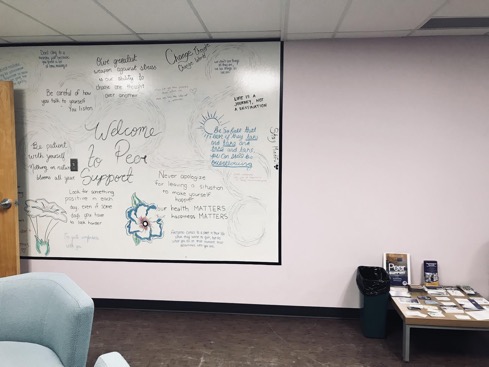
Having been a volunteer at the Peer Support Centre for my third year now, it has been so rewarding to see how much the centre’s reputation has grown on campus. Two years ago, it was exciting news to hear of one single student coming in to the centre; now, almost every one of our volunteers has seen and helped a fellow student! The fact that students are becoming more aware of our service and feel comfortable coming to us to seek help is an amazing feeling. As final exams slowly approach, good mental health is more important than ever; I hope more and more students become aware of our amazing service and the help we have to offer. Nothing is more rewarding than seeing students leave the centre with a big thankful smile on their face! I am so honoured to play an integral role in making Western’s community happier, healthier, and safer, through the Peer Support Centre. Come pay us a visit at the UCC in room 256, from Monday to Friday during between 10-4 PM. Want more information about us or about any other affiliate services Western has to offer? Check out our Facebook page, “Peer Support at Western University” (https://www.facebook.com/PeerSupportWestern/) and our Instagram page, “https://www.instagram.com peersupportwestern/”.
Have a great day!
-Written by Dana Abossi, a 4th year biology student at Western University
The Peer Support Centre, or as we like to call it the ‘PSC’, focuses on a clear and specific motto: “Listen, Affirm, and Refer”. You come to the space, we make you feel welcome, and you talk to us. We listen to you, validate your feelings, and refer you to the appropriate resource on or off campus; we tailor your needs to the best option there is. No problem is too small and everyone needs a listening ear sometimes. Students helping students, it is as simple as that.
Having been a volunteer at the Peer Support Centre for my third year now, it has been so rewarding to see how much the centre’s reputation has grown on campus. Two years ago, it was exciting news to hear of one single student coming in to the centre; now, almost every one of our volunteers has seen and helped a fellow student! The fact that students are becoming more aware of our service and feel comfortable coming to us to seek help is an amazing feeling. As final exams slowly approach, good mental health is more important than ever; I hope more and more students become aware of our amazing service and the help we have to offer. Nothing is more rewarding than seeing students leave the centre with a big thankful smile on their face! I am so honoured to play an integral role in making Western’s community happier, healthier, and safer, through the Peer Support Centre. Come pay us a visit at the UCC in room 256, from Monday to Friday during between 10-4 PM. Want more information about us or about any other affiliate services Western has to offer? Check out our Facebook page, “Peer Support at Western University” (https://www.facebook.com/PeerSupportWestern/) and our Instagram page, “https://www.instagram.com peersupportwestern/”.
Have a great day!
-Written by Dana Abossi, a 4th year biology student at Western University